Conversion rate optimization helps you get more value from the website traffic you already have. Instead of focusing only on attracting more visitors, it improves the percentage of people who complete a meaningful action, such as submitting a form, booking a consultation, requesting a quote, starting a trial, or making a purchase.
Traffic alone does not grow a business. A website can attract thousands of visitors and still underperform if its message is unclear, pages load slowly, forms create friction, or calls to action are difficult to find.
The goal is not to pressure visitors into clicking.
It is to remove uncertainty, make decisions easier, and create a smoother journey from interest to action.
Here are 15 proven ways to improve your website and generate more qualified leads.
Traffic alone does not grow a business. A website can attract thousands of visitors and still underperform if its message is unclear, pages load slowly, forms create friction, or calls to action are difficult to find.
The goal is not to pressure visitors into clicking.
It is to remove uncertainty, make decisions easier, and create a smoother journey from interest to action.
Here are 15 proven ways to improve your website and generate more qualified leads.
Table of Contents
1. Define the conversion that matters
2. Find where visitors drop off
3. Strengthen your value proposition
4. Improve your calls to action
5. Match landing pages to visitor intent
6. Simplify lead forms
7. Add stronger trust signals
8. Improve page speed
9. Optimize the mobile experience
10. Remove unnecessary distractions
11. Use stronger social proof
12. Prioritize high-intent pages
13. Run focused A/B tests
14. Improve lead follow-up
15. Measure lead quality
16. Frequently asked questions
1. Define the conversion that matters
2. Find where visitors drop off
3. Strengthen your value proposition
4. Improve your calls to action
5. Match landing pages to visitor intent
6. Simplify lead forms
7. Add stronger trust signals
8. Improve page speed
9. Optimize the mobile experience
10. Remove unnecessary distractions
11. Use stronger social proof
12. Prioritize high-intent pages
13. Run focused A/B tests
14. Improve lead follow-up
15. Measure lead quality
16. Frequently asked questions
What Is Conversion Rate Optimization?
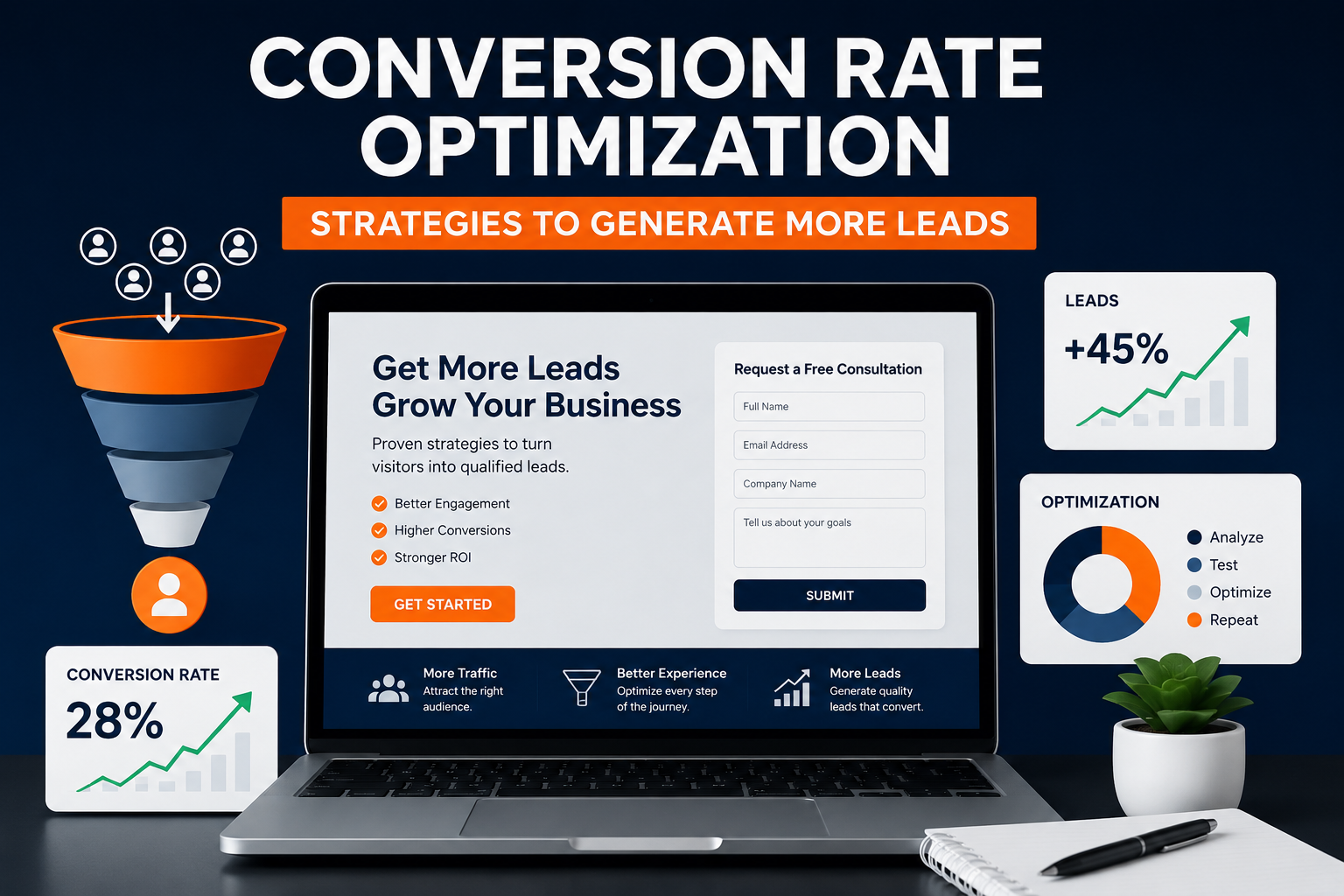
Conversion rate optimization is the process of improving a website, landing page, or customer journey so a greater percentage of visitors complete a desired action.
The basic formula is:
Conversion Rate = (Conversions ÷ Visitors) × 100
For example, if 1,000 people visit a landing page and 50 submit an enquiry form, the page has a 5% conversion rate.
The right conversion depends on the business.
An ecommerce company may prioritize purchases. A professional services company may care more about qualified consultation requests, while a SaaS company could focus on demo bookings or trial registrations.
The important part is optimizing for actions that move people closer to becoming customers.
The basic formula is:
Conversion Rate = (Conversions ÷ Visitors) × 100
For example, if 1,000 people visit a landing page and 50 submit an enquiry form, the page has a 5% conversion rate.
The right conversion depends on the business.
An ecommerce company may prioritize purchases. A professional services company may care more about qualified consultation requests, while a SaaS company could focus on demo bookings or trial registrations.
The important part is optimizing for actions that move people closer to becoming customers.
1. Define the Conversion That Actually Matters
Before changing your website design, buttons, forms, or landing pages, define what a successful conversion actually means.
Many businesses track convenient actions instead of valuable ones.
A newsletter signup may be useful, but it should not necessarily carry the same weight as a qualified sales enquiry.
Start by separating primary and secondary conversions.
Primary conversions may include:
• Consultation bookings
• Quote requests
• Purchases
• Demo requests
• Qualified enquiry forms
• Phone calls
• Appointment bookings
Secondary conversions may include:
• Newsletter signups
• Brochure downloads
• Video views
• Account creation
• Content downloads
Google Analytics allows businesses to identify important user actions as key events, including actions such as completed lead-generation forms. Measuring these events gives you a stronger baseline before making major conversion rate optimization changes.
Do not begin optimizing until you know which actions actually matter to the business.
Many businesses track convenient actions instead of valuable ones.
A newsletter signup may be useful, but it should not necessarily carry the same weight as a qualified sales enquiry.
Start by separating primary and secondary conversions.
Primary conversions may include:
• Consultation bookings
• Quote requests
• Purchases
• Demo requests
• Qualified enquiry forms
• Phone calls
• Appointment bookings
Secondary conversions may include:
• Newsletter signups
• Brochure downloads
• Video views
• Account creation
• Content downloads
Google Analytics allows businesses to identify important user actions as key events, including actions such as completed lead-generation forms. Measuring these events gives you a stronger baseline before making major conversion rate optimization changes.
Do not begin optimizing until you know which actions actually matter to the business.
2. Find Where Visitors Are Dropping Off
Do not redesign a page simply because it feels outdated.
Start with evidence.
Look at your analytics to identify pages receiving meaningful traffic but producing weak engagement or few inquiries.
Then ask:
• Which landing pages receive the most traffic?
• Which pages generate leads?
• Where do visitors leave?
• Which devices perform poorly?
• Are visitors reaching the form but not completing it?
• Which traffic sources generate the strongest leads?
• Where does the customer journey slow down?
Analytics tells you what is happening.
Session recordings, heatmaps, surveys, customer feedback, and usability testing can help explain why.
Once you identify the friction, you can make a targeted improvement instead of guessing.
Start with evidence.
Look at your analytics to identify pages receiving meaningful traffic but producing weak engagement or few inquiries.
Then ask:
• Which landing pages receive the most traffic?
• Which pages generate leads?
• Where do visitors leave?
• Which devices perform poorly?
• Are visitors reaching the form but not completing it?
• Which traffic sources generate the strongest leads?
• Where does the customer journey slow down?
Analytics tells you what is happening.
Session recordings, heatmaps, surveys, customer feedback, and usability testing can help explain why.
Once you identify the friction, you can make a targeted improvement instead of guessing.
3. Make Your Value Proposition Immediately Clear
Visitors should quickly understand what you offer, who it is for, and why they should care. Generic statements such as, "Innovative solutions for modern businesses." say very little.
A stronger value proposition answers three questions:
✔ What do you provide?
✔ Who is it for?
✔ What result does it help create?
For example:
Weak: Digital marketing solutions for growing businesses.
Stronger: SEO and paid media strategies designed to generate qualified leads for growing businesses.
Specificity reduces the amount of work visitors need to do to understand your offer.
Place the primary value proposition prominently near the top of important landing and service pages.
Then reinforce it throughout the page.
A stronger value proposition answers three questions:
✔ What do you provide?
✔ Who is it for?
✔ What result does it help create?
For example:
Weak: Digital marketing solutions for growing businesses.
Stronger: SEO and paid media strategies designed to generate qualified leads for growing businesses.
Specificity reduces the amount of work visitors need to do to understand your offer.
Place the primary value proposition prominently near the top of important landing and service pages.
Then reinforce it throughout the page.
4. Use Clear and Specific Calls to Action
Your call to action should explain what happens after someone clicks.
Buttons such as:
• Submit
• Click Here
• Continue
• Learn More
can be vague.
Nielsen Norman Group recommends using specific calls to action and link labels that give users stronger information about what they can expect after clicking.
Compare these examples:
Weak: Submit
Better: Request My Free Audit
Weak: Learn More
Better: View Our SEO Services
Weak: Contact Us
Better: Schedule a Consultation
Good conversion rate optimization also means matching the CTA to the visitor's level of intent.
Someone reading an educational article may be better suited to a checklist or guide.
Someone reviewing a service page may already be ready to book a consultation.
Do not force every visitor toward exactly the same action.
Buttons such as:
• Submit
• Click Here
• Continue
• Learn More
can be vague.
Nielsen Norman Group recommends using specific calls to action and link labels that give users stronger information about what they can expect after clicking.
Compare these examples:
Weak: Submit
Better: Request My Free Audit
Weak: Learn More
Better: View Our SEO Services
Weak: Contact Us
Better: Schedule a Consultation
Good conversion rate optimization also means matching the CTA to the visitor's level of intent.
Someone reading an educational article may be better suited to a checklist or guide.
Someone reviewing a service page may already be ready to book a consultation.
Do not force every visitor toward exactly the same action.
5. Match Your Landing Page to Visitor Intent
The experience after the click should match the promise before it.
If an ad offers a Free Website Audit, the visitor should arrive on a page focused on that audit.
Do not send them to a generic homepage containing nine unrelated services.
Keep these elements aligned:
• Ad or search message
• Landing-page headline
• Offer
• Supporting copy
• Visuals
• CTA
• Form
This is especially important when investing in paid advertising.
Strong Google or Meta targeting cannot fully compensate for a landing page that does not match the message that generated the click.
A clear message match reduces uncertainty and makes the next step easier.
If an ad offers a Free Website Audit, the visitor should arrive on a page focused on that audit.
Do not send them to a generic homepage containing nine unrelated services.
Keep these elements aligned:
• Ad or search message
• Landing-page headline
• Offer
• Supporting copy
• Visuals
• CTA
• Form
This is especially important when investing in paid advertising.
Strong Google or Meta targeting cannot fully compensate for a landing page that does not match the message that generated the click.
A clear message match reduces uncertainty and makes the next step easier.
6. Simplify Your Lead Forms
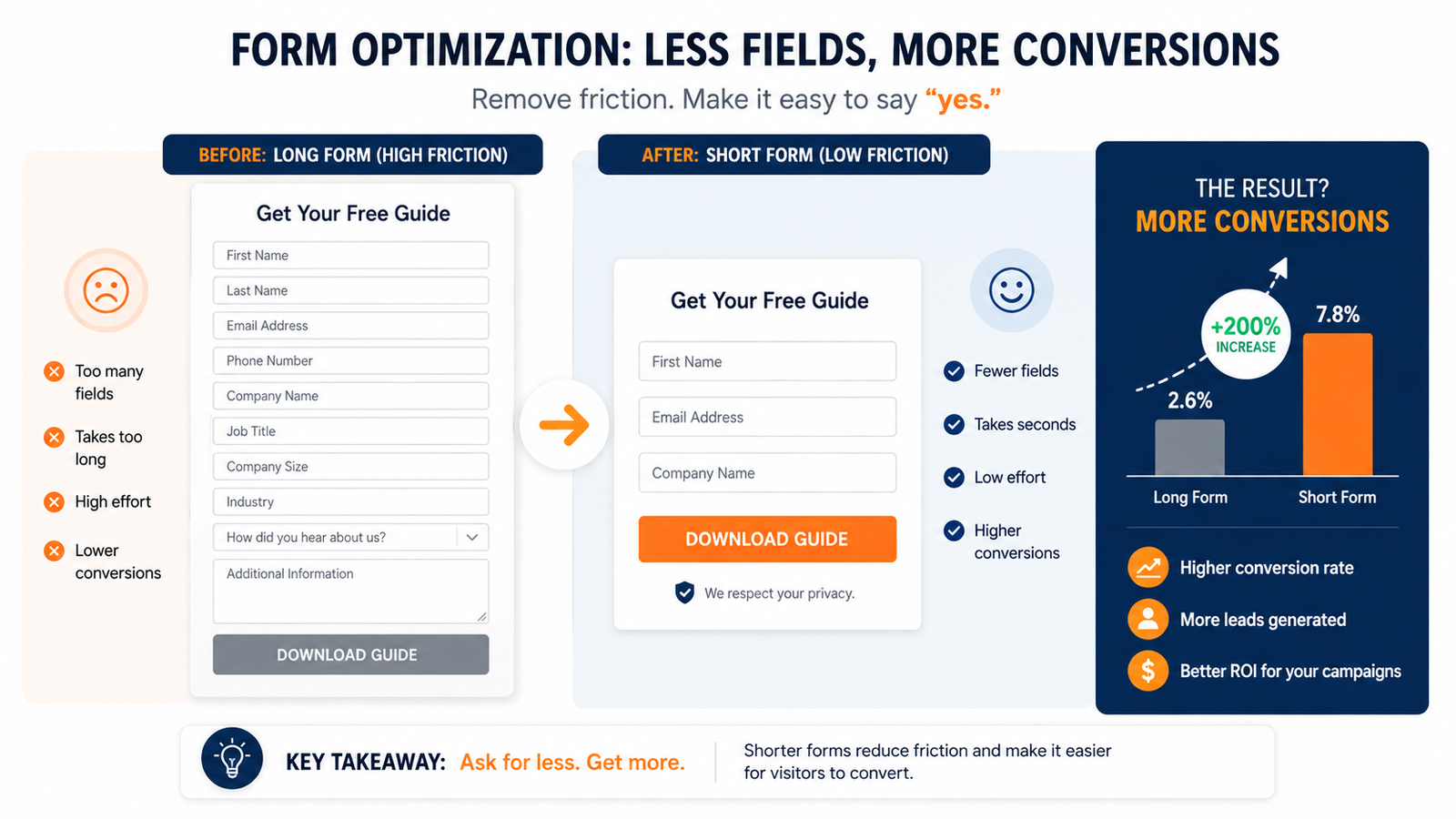
Every form field creates another task for the visitor.
Ask only for information you genuinely need at that stage of the relationship.
You can gather additional details after the person becomes a lead.
Nielsen Norman Group's research on reducing cognitive load in forms emphasizes structure, transparency, clarity, and support so users can complete forms with less mental effort.
For an initial consultation, you might only need:
• Name
• Email
• Company
• Website
• Brief description of the challenge
Longer qualification forms can make sense for expensive or highly specialized services.
But every question should earn its place.
Also:
• Make required fields obvious.
• Use clear labels.
• Explain unusual questions.
• Provide useful error messages.
• Avoid resetting completed fields after an error.
• Test the form on mobile.
Reducing unnecessary friction can make it easier for an interested visitor to become a lead.
Ask only for information you genuinely need at that stage of the relationship.
You can gather additional details after the person becomes a lead.
Nielsen Norman Group's research on reducing cognitive load in forms emphasizes structure, transparency, clarity, and support so users can complete forms with less mental effort.
For an initial consultation, you might only need:
• Name
• Company
• Website
• Brief description of the challenge
Longer qualification forms can make sense for expensive or highly specialized services.
But every question should earn its place.
Also:
• Make required fields obvious.
• Use clear labels.
• Explain unusual questions.
• Provide useful error messages.
• Avoid resetting completed fields after an error.
• Test the form on mobile.
Reducing unnecessary friction can make it easier for an interested visitor to become a lead.
7. Add Trust Signals Close to the Decision
People hesitate when they are unsure whether they can trust the company behind the page.
Do not hide all your credibility on the About page.
Put relevant proof near the points where visitors are deciding whether to act.
Useful trust signals can include:
• Client logos
• Testimonials
• Case studies
• Certifications
• Awards
• Review ratings
• Industry affiliations
• Security information
• Guarantees
• Media mentions
• Clear contact information
Specific evidence usually works better than broad claims.
Instead of: "We deliver excellent results."
Use: "Increased qualified enquiries by 38% after restructuring the landing page and paid campaign."
Use numbers only when you can substantiate them. Your proof should reduce a real objection, not simply decorate the page.
Do not hide all your credibility on the About page.
Put relevant proof near the points where visitors are deciding whether to act.
Useful trust signals can include:
• Client logos
• Testimonials
• Case studies
• Certifications
• Awards
• Review ratings
• Industry affiliations
• Security information
• Guarantees
• Media mentions
• Clear contact information
Specific evidence usually works better than broad claims.
Instead of: "We deliver excellent results."
Use: "Increased qualified enquiries by 38% after restructuring the landing page and paid campaign."
Use numbers only when you can substantiate them. Your proof should reduce a real objection, not simply decorate the page.
8. Improve Page Speed and Stability
A visitor cannot convert easily if the page takes too long to become usable.
Google's current Core Web Vitals guidance recommends aiming for:
LCP: 2.5 seconds or less
INP: Less than 200 milliseconds
CLS: 0.1 or less
These metrics measure loading performance, responsiveness, and visual stability.
For conversion rate optimization, the practical objective is straightforward:
Make important pages fast, stable, and easy to use.
Start by:
1. Compressing oversized images.
2. Removing unnecessary scripts.
3. Improving server response time.
4. Lazy-loading non-critical assets.
5. Preventing unexpected layout shifts.
6. Limiting heavy third-party widgets.
7. Testing key pages on real devices.
Do not obsess over achieving a perfect performance score while ignoring your offer or messaging.
Speed helps remove friction.
It cannot rescue a page that gives visitors no reason to convert.
Google's current Core Web Vitals guidance recommends aiming for:
LCP: 2.5 seconds or less
INP: Less than 200 milliseconds
CLS: 0.1 or less
These metrics measure loading performance, responsiveness, and visual stability.
For conversion rate optimization, the practical objective is straightforward:
Make important pages fast, stable, and easy to use.
Start by:
1. Compressing oversized images.
2. Removing unnecessary scripts.
3. Improving server response time.
4. Lazy-loading non-critical assets.
5. Preventing unexpected layout shifts.
6. Limiting heavy third-party widgets.
7. Testing key pages on real devices.
Do not obsess over achieving a perfect performance score while ignoring your offer or messaging.
Speed helps remove friction.
It cannot rescue a page that gives visitors no reason to convert.
9. Make Mobile Conversion Easier
A page that works on desktop can still be frustrating on a phone. Test your complete conversion journey on an actual mobile device.
Always ask these following questions:
• Is the headline readable immediately?
• Are buttons easy to tap?
• Is the form comfortable to complete?
• Does the keyboard cover important fields?
• Can users easily call the business?
• Are popups blocking content?
• Does the menu take over the screen?
• Is the CTA easy to find after scrolling?
Remove unnecessary steps.
If phone calls are valuable, make the phone number clickable. If appointment bookings matter, reduce the number of screens required to complete the process.
Mobile should not feel like a compressed desktop website. It should feel intentionally designed for the smaller screen.
Always ask these following questions:
• Is the headline readable immediately?
• Are buttons easy to tap?
• Is the form comfortable to complete?
• Does the keyboard cover important fields?
• Can users easily call the business?
• Are popups blocking content?
• Does the menu take over the screen?
• Is the CTA easy to find after scrolling?
Remove unnecessary steps.
If phone calls are valuable, make the phone number clickable. If appointment bookings matter, reduce the number of screens required to complete the process.
Mobile should not feel like a compressed desktop website. It should feel intentionally designed for the smaller screen.
10. Remove Unnecessary Distractions
More choices do not always generate more conversions. A visitor on a high-intent landing page may not need:
• Links to every blog category
• Several competing offers
• Multiple newsletter popups
• Social-media widgets
• Unrelated announcements
• Five different CTA buttons
Conversion rate optimization often means deciding what to remove.
One important question you should always ask, "Does this element help the visitor make the next decision?"
If the answer is no, test whether it belongs on the page.
A strong high-intent page usually has a clear hierarchy:
Headline → Value → Proof → Offer → CTA
Supporting content should help the visitor make a decision rather than pull attention somewhere else.
• Links to every blog category
• Several competing offers
• Multiple newsletter popups
• Social-media widgets
• Unrelated announcements
• Five different CTA buttons
Conversion rate optimization often means deciding what to remove.
One important question you should always ask, "Does this element help the visitor make the next decision?"
If the answer is no, test whether it belongs on the page.
A strong high-intent page usually has a clear hierarchy:
Headline → Value → Proof → Offer → CTA
Supporting content should help the visitor make a decision rather than pull attention somewhere else.
11. Use Social Proof That Answers Real Objections
Testimonials become more valuable when they explain something a prospect actually wants to know.
Compare the following reviews:
"Great service. Highly recommended."
vs
"We were struggling to generate qualified enquiries from our website. After rebuilding the campaign and landing page, lead quality improved and our sales team had more relevant prospects to contact."
The second example gives context.
Strong social proof can explain:
• The original problem
• Why the customer chose you
• What was changed
• How the process worked
• What outcome occurred
Where possible, include:
• Name
• Company
• Role
• Photo
• Specific result
with the client's permission.
Match the proof to the service being promoted.
SEO prospects should see SEO evidence. Paid-media prospects should see advertising results. Website-design prospects should see website or conversion outcomes.
Compare the following reviews:
"Great service. Highly recommended."
vs
"We were struggling to generate qualified enquiries from our website. After rebuilding the campaign and landing page, lead quality improved and our sales team had more relevant prospects to contact."
The second example gives context.
Strong social proof can explain:
• The original problem
• Why the customer chose you
• What was changed
• How the process worked
• What outcome occurred
Where possible, include:
• Name
• Company
• Role
• Photo
• Specific result
with the client's permission.
Match the proof to the service being promoted.
SEO prospects should see SEO evidence. Paid-media prospects should see advertising results. Website-design prospects should see website or conversion outcomes.
12. Optimize High-Intent Pages First
You do not need to optimize your entire website at once.
Start with pages closest to revenue.
Typical priorities include:
• Service pages
• Product pages
• Pricing pages
• Lead-generation landing pages
• Contact pages
• Booking pages
• High-performing articles that influence inquiries
A small improvement on a commercial page can create more business value than a major improvement on a page with very little purchase intent.
Use traffic, conversion, and sales data together.
This helps determine where conversion rate optimization has the greatest potential financial impact.
Start with pages closest to revenue.
Typical priorities include:
• Service pages
• Product pages
• Pricing pages
• Lead-generation landing pages
• Contact pages
• Booking pages
• High-performing articles that influence inquiries
A small improvement on a commercial page can create more business value than a major improvement on a page with very little purchase intent.
Use traffic, conversion, and sales data together.
This helps determine where conversion rate optimization has the greatest potential financial impact.
13. Run Focused A/B Tests
Testing works best when it starts with a clear hypothesis.
Do not simultaneously change:
• The headline
• Button
• Hero image
• Form
• Pricing
• Offer
• Page layout
If performance improves, you will not know which change caused it.
Nielsen Norman Group's guidance on A/B testing recommends starting with a hypothesis and testing focused changes rather than making an extensive redesign that makes the result difficult to interpret.
For example:
"Because visitors may not understand what happens after completing the form, changing “Submit” to “Request My Free Audit” should increase completed audit requests."
Possible tests include:
• Headline
• CTA copy
• Form length
• Offer
• Hero section
• Testimonial placement
• Pricing display
• Landing-page layout
Test changes that could meaningfully affect behavior.
Do not spend weeks testing insignificant details while obvious problems remain unfixed.
Do not simultaneously change:
• The headline
• Button
• Hero image
• Form
• Pricing
• Offer
• Page layout
If performance improves, you will not know which change caused it.
Nielsen Norman Group's guidance on A/B testing recommends starting with a hypothesis and testing focused changes rather than making an extensive redesign that makes the result difficult to interpret.
For example:
"Because visitors may not understand what happens after completing the form, changing “Submit” to “Request My Free Audit” should increase completed audit requests."
Possible tests include:
• Headline
• CTA copy
• Form length
• Offer
• Hero section
• Testimonial placement
• Pricing display
• Landing-page layout
Test changes that could meaningfully affect behavior.
Do not spend weeks testing insignificant details while obvious problems remain unfixed.
14. Improve What Happens After Form Submission
The customer journey does not end when someone clicks Submit.
Tell the lead what happens next.
A good confirmation page or message can explain:
• That the submission was received
• When the person should expect a response
• Who will contact them
• What they should prepare
• What they can read while waiting
Then make sure your business actually follows through.
Poor lead handling can erase the gains created by a better website.
For high-value services, marketing and sales should agree on:
• What counts as a qualified lead
• Who receives it
• How quickly the lead is contacted
• How follow-up is recorded
• When leads enter nurture campaigns
Improving the website is only one part of improving the conversion system.
Tell the lead what happens next.
A good confirmation page or message can explain:
• That the submission was received
• When the person should expect a response
• Who will contact them
• What they should prepare
• What they can read while waiting
Then make sure your business actually follows through.
Poor lead handling can erase the gains created by a better website.
For high-value services, marketing and sales should agree on:
• What counts as a qualified lead
• Who receives it
• How quickly the lead is contacted
• How follow-up is recorded
• When leads enter nurture campaigns
Improving the website is only one part of improving the conversion system.
15. Measure Lead Quality, Not Just Lead Volume
A higher conversion rate does not automatically mean better results.
Suppose a new form increases monthly inquiries from 40 to 70.
That looks successful.
But what if 25 of those additional inquiries are irrelevant, spam, or prospects who could never become customers?
Track what happens after the conversion.
Measure:
• Qualified lead rate
• Sales opportunities
• Booked appointments
• Appointment attendance
• Close rate
• Customer acquisition cost
• Revenue
• Customer lifetime value
This is where conversion rate optimization becomes a business discipline rather than simply a website-design exercise.
The best-performing page is not necessarily the one that generates the highest number of form submissions. It is the page that contributes to more valuable customer outcomes.
Suppose a new form increases monthly inquiries from 40 to 70.
That looks successful.
But what if 25 of those additional inquiries are irrelevant, spam, or prospects who could never become customers?
Track what happens after the conversion.
Measure:
• Qualified lead rate
• Sales opportunities
• Booked appointments
• Appointment attendance
• Close rate
• Customer acquisition cost
• Revenue
• Customer lifetime value
This is where conversion rate optimization becomes a business discipline rather than simply a website-design exercise.
The best-performing page is not necessarily the one that generates the highest number of form submissions. It is the page that contributes to more valuable customer outcomes.
Frequently Asked Questions
There is no universal conversion rate that every website should target.
Performance varies based on:
- Industry
- Offer
- Traffic source
- Device
- Conversion type
- Price
- Audience
- Customer journey
Use your current performance as the baseline and focus on improving qualified business outcomes rather than chasing a generic industry percentage.
SEO and CRO have different primary objectives, but they work well together.
SEO helps attract relevant organic visitors.
CRO helps more of those visitors take valuable actions once they reach your website.
Google also encourages site owners to provide a strong overall page experience rather than focusing on one isolated metric.
Some improvements can produce results quickly, especially when they fix obvious usability problems.
A/B tests normally take longer because you need enough traffic and conversions to make a meaningful comparison.
The timeline depends on:
- Website traffic
- Existing conversion volume
- Test size
- Sales cycle
- Significance of the change
Avoid declaring a winner based on only a handful of conversions.
If your website already receives relevant traffic but generates very few inquiries, improving conversion may provide more immediate value than simply attracting additional visitors.
If traffic is still very low, you may need acquisition and conversion improvements simultaneously.
The two strategies support each other.
Why is Conversion Rate Optimization Important for Businesses?
Conversion rate optimization is not about discovering one button color, headline formula, or landing-page trick that suddenly doubles your revenue.
It is a continuous process of understanding your visitors, finding friction, making improvements, testing important changes, and measuring whether those changes create better business outcomes.
Start with the pages closest to revenue.
Make your offer clearer. Remove unnecessary barriers. Strengthen trust. Improve your CTAs. Simplify forms. Test the mobile journey. Then measure what happens after each lead enters your sales process.
SearchJet approaches digital marketing as a connected acquisition system, where SEO, paid media, content, website experience, and conversion performance support the same goal: generating measurable business growth.
If your website is attracting visitors but not enough qualified enquiries, start by finding where the customer journey is breaking and fix the highest-impact problems first.
It is a continuous process of understanding your visitors, finding friction, making improvements, testing important changes, and measuring whether those changes create better business outcomes.
Start with the pages closest to revenue.
Make your offer clearer. Remove unnecessary barriers. Strengthen trust. Improve your CTAs. Simplify forms. Test the mobile journey. Then measure what happens after each lead enters your sales process.
SearchJet approaches digital marketing as a connected acquisition system, where SEO, paid media, content, website experience, and conversion performance support the same goal: generating measurable business growth.
If your website is attracting visitors but not enough qualified enquiries, start by finding where the customer journey is breaking and fix the highest-impact problems first.